Marco Guidelines · Oncology clinical guidelines
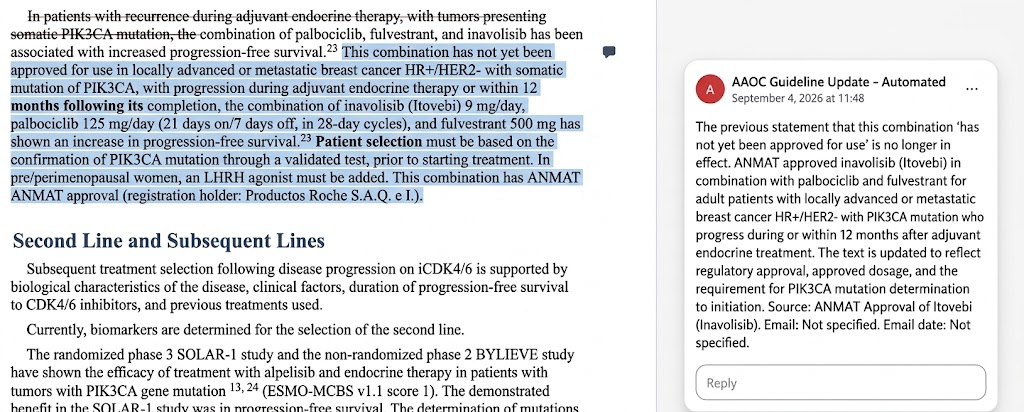
Every week, Marco Guidelines reviews international evidence and your country's regulatory approvals, checks them against your current guideline, and delivers the proposed changes inside your own document. The committee accepts or rejects. The decision stays medical.
The cost of the lag
9 years
From finding to guideline
The estimated average delay between the start of human research and its arrival in clinical guidelines. Of that total, between 1.7 and 3 years pass after the trial is published: the study is already available and the guideline still hasn't picked it up.
1 in 5
Recommendations out of date at 3 years
Validity falls from 92% in the first year to 81% by the third. Around half of all guidelines are out of date by 5.8 years.
Making a decision is quick
It’s the process leading up to it that takes time
The committee doesn't take years to decide. It takes time searching, cross-checking against the drug registry, finding the paragraphs, drafting and documenting. Volunteer work that competes with clinical duties.
How it works
01
International evidence, phase III results, drug label changes and rulings from the national health authority.
02
Compares the findings against the current text, section by section, including algorithms, tables and footnotes.
03
Every change with its section, type, current text, proposed text and rationale with a cited source.
04
As tracked changes in the committee's document, with the rationale in the margin.
05
Nothing is merged on its own. The committee accepts, rejects or edits each proposal.
What nobody is watching
A trial is published that changes practice and the guideline doesn't take it in. This is the ageing everyone recognises, and the one committees try to cover by reviewing the literature.
The national authority approves a drug or lifts a restriction, and the guideline keeps saying otherwise. This doesn't surface by reading international publications: it isn't an evidence problem, it's a mismatch between the guideline and the national drug registry.
The second is the more urgent one for the patient. If the guideline omits a recent trial, the clinician can still apply their judgement. If it states that a drug isn't approved in the country when it is, it actively blocks a viable indication. Marco Guidelines watches both fronts.
AAOC case · Argentine Association of Clinical Oncology
Section
Treatment of extensive disease › Algorithm 6 Treatment of localised and extensive disease
Change type
Modification
Current text
Not approved by ANMAT
Proposed text
Verify current ANMAT approval for each agent. Lurbinectedin in combination with atezolizumab holds ANMAT approval (Certificate No. 60,377) for maintenance in ES-SCLC and as a single agent in metastatic SCLC with post-platinum progression
Every proposal states the section, the type of change, the current text and its replacement, and attaches the rationale with its source and certificate number. Example translated from the original Spanish-language document.
Value by stakeholder
The medical society
The health authority
The clinician and the patient
Marco Guidelines proposes. The committee decides. Always. No change is merged automatically. Authorship, editorial judgement and responsibility remain entirely with the institution that publishes the guideline.
Get started
To review a current guideline and see the first change report on your own document.